
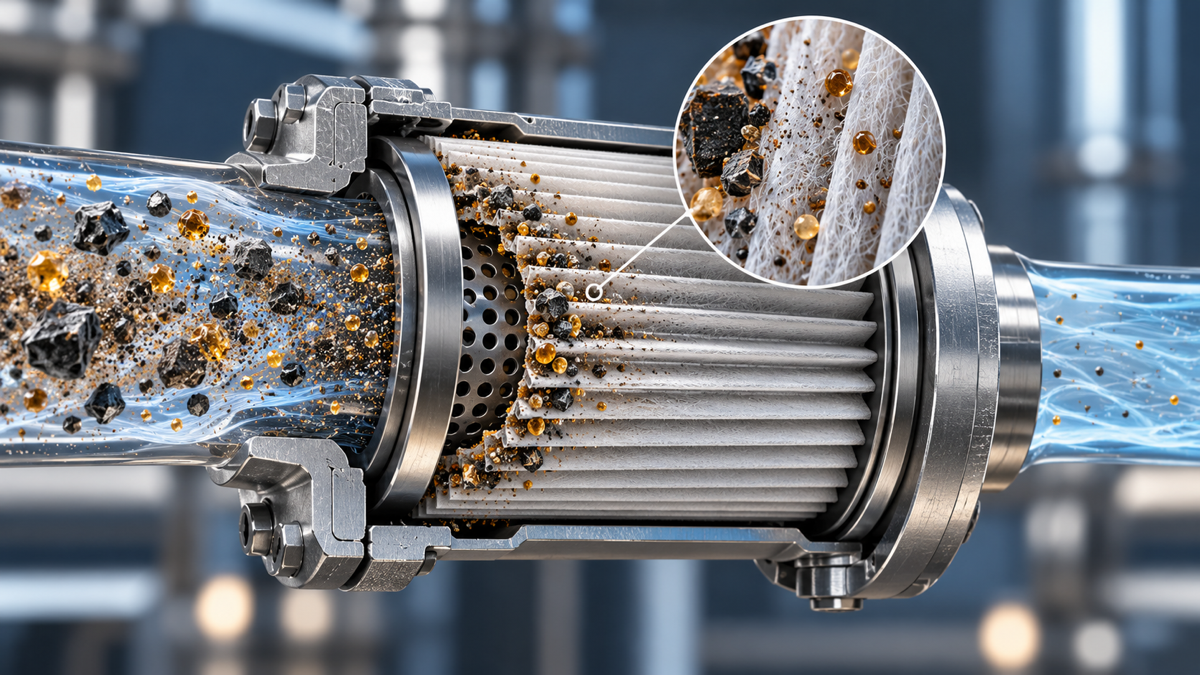
Two filter elements are both labelled “10 micron” and fit the same housing. Are they interchangeable? Micron size and dimensions alone cannot establish equivalence. The rating also needs an efficiency, a test basis and an identified product. Suitability for hot thermal oil requires separate engineering evidence.
This guide explains how to compare filtration ratings and procurement documents. It does not prescribe a universal micron rating, replacement differential pressure or field operating procedure.
A micron is a unit of length, not efficiency. Donaldson explains that a particle size is of limited value without the efficiency at that size; an efficiency is likewise incomplete without its associated particle size.[1]
Terms such as “nominal” and “absolute” require the manufacturer's definition and test basis. Do not assume that every supplier applies the same threshold, or interpret “absolute” as a promise that no relevant particle can pass. Ask: what beta ratio applies at 10 microns, for which element and under which test?
The beta ratio relates upstream and downstream particle counts or concentrations under the applicable test and size-counting convention. Upstream means before filtration; downstream means after filtration. Counts are commonly cumulative at and above a specified size threshold, but the report's definition must be retained.
β = relevant upstream particle count ÷ relevant downstream particle count.
Both sides must use consistent sampling and counting bases. Preserve size notation, calibration identifiers, subscripts and method versions. Matching numbers do not establish equivalence between different counting systems, and buyers should not invent size conversions.
Beta is not a flow ratio, pressure-drop ratio or dirt-holding capacity. A higher beta indicates higher associated retention efficiency only for the corresponding size and comparable test conditions.
On the applicable counting basis, efficiency η = (1 − 1/β) × 100%. The following are mathematical examples, not specifications for thermal oil service.
| Beta ratio | Associated particle-count efficiency |
|---|---|
| 2 | 50% |
| 20 | 95% |
| 200 | 99.5% |
| 1000 | 99.9% |
For example, 20,000 relevant upstream particles and 100 downstream particles on matching count bases give beta 200 and 99.5% efficiency. This does not mean that 99.5% of all contamination in a plant has been removed. It does not establish the same efficiency for smaller particles or the same percentage removal by contaminant mass.
Two 10-micron elements can have different beta ratios and therefore different associated retention performance. Conversely, the same beta at different particle sizes is not an equivalent rating.
Finer or more efficient does not automatically mean better for the duty. The target particles, flow requirements, contamination load and equipment conditions must also be considered. Matching dimensions address geometry, not equivalence of media, seals, pressure drop or filtration performance.
Donaldson describes testing with particle counters and test dust, comparing counts before and after filtration, and refers to ISO 16889.[1] This article uses that explanatory source; it does not claim a review of the full standard or independent verification of a particular element's test report.
Identify the exact model, media and construction revision. Establish whether a result describes a complete element or a media specimen. Media-level results cannot be extended without justification to elements of different lengths or construction, and a series brochure is not proof for every configuration.
Check the test fluid, temperature or viscosity, flow rate, contaminant, counting basis and reporting method. A single beta value obtained under different conditions should not be ranked against another without explanation.
Where efficiency changes during loading, identify whether the quoted value is initial, stage-specific or aggregated, and what part of the test it covers. Do not select only the best point. A manufacturer's declaration should remain labelled as such; a stamp does not turn it into an independently verified test.
Efficiency describes retention at the associated particle size. Dirt-holding capacity concerns the contaminant retained under stated conditions. Clean-element pressure drop depends on fluid, flow and construction. A high beta does not automatically establish long service life or low pressure drop.
Obtain separate evidence for each performance characteristic, then let the equipment team evaluate the actual duty. A procurement rating is not a field diagnosis or replacement instruction. For operating symptoms, see our separate guide to rising heat transfer fluid filter differential pressure.
Thermal oil applications also require compatibility of the media, support structure, bonding materials and seals with the identified fluid and temperature. Good hydraulic-test performance does not establish mechanical or chemical suitability in a hot heat-transfer circuit.
The equipment and element suppliers should assess pressure, temperature, flow and fluid condition. Efficiency evidence does not replace pressure integrity, sealing or structural validation. A general material-temperature table is not approval of the complete element.
Actual flow through the media, housing and seal fit, bypass arrangements, branch flows and continuing contamination all affect system performance. Identify a bypass by its design function; the presence of a valve does not itself prove ineffective filtration. Do not alter components merely to increase the fraction of flow filtered.
Repeated circulation does not automatically guarantee a final cleanliness level. Predicting cleanup time from a test efficiency requires additional modelling and validation. Filtration alone cannot remedy every existing deposit, chemical change in the fluid or mechanical fault.
Identity: manufacturer, full model, media and construction revision, and the link between the report and supplied product.
Rating: original size notation, beta or efficiency, counting calibration basis, method and version.
Conditions: fluid, temperature or viscosity, flow, contaminant and statistical reporting basis.
Other performance: dirt capacity and clean pressure drop with their conditions.
Application: identified thermal fluid, temperature and pressure envelope, seals, supports and equipment-review gaps.
Change control: differences between replacement models, revision changes and the continuing applicability of older reports.
If supplier A provides size and beta while supplier B only states “10-micron absolute,” the evidence is differently complete; that alone does not prove B performs better. If both ratings match but only one product has documented project-specific compatibility, record the other product's application evidence as unresolved rather than declaring it unusable without assessment.
Read “10 micron” together with beta ratio, test conditions and element identity. Evaluate efficiency, dirt capacity, pressure drop and hot-fluid compatibility separately. A test rating, project selection approval and permission for field use are different decisions—not a single claim of interchangeability.
[1] Donaldson, Understanding Beta Ratings in Liquid Filters, checked online on 13 October 2026. This source supports the size-efficiency relationship, upstream/downstream count ratio, efficiency conversion and test principles. Numerical examples are not product specifications. Hot thermal oil suitability requires separate project evidence. The full ISO 16889 standard was not reviewed; this guide does not replace the standard, an element test report or engineering design.