
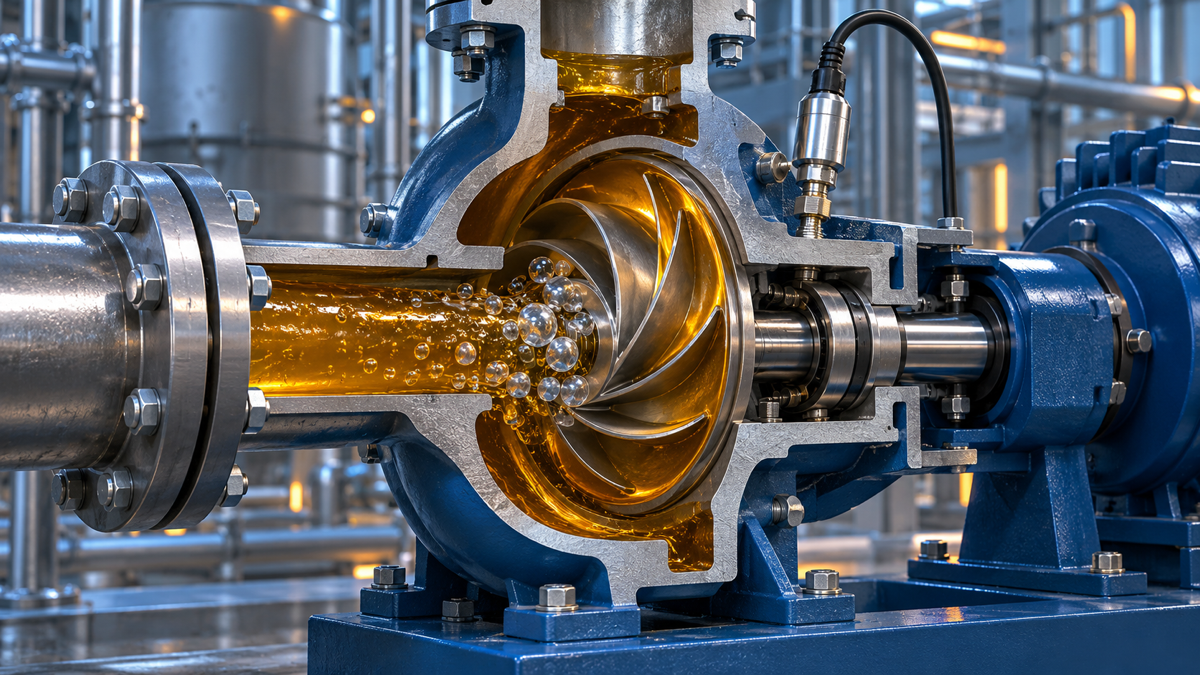
Does noise, increased vibration and falling flow from a thermal oil circulation pump prove cavitation? No—not on those symptoms alone. Mechanical faults, entrained gas, suction restrictions and measurement problems can produce similar observations. A preliminary assessment needs to connect the symptoms with local conditions, the pump curve and an event timeline.
This article addresses centrifugal pumps in heat transfer fluid systems. It explains how to organize evidence, not how to adjust pressure, throttle valves, vent fluid or authorize a restart. Respond to abnormalities under site procedures first; evidence collection must not delay necessary action.
The main mechanism considered here is vapor cavitation: local static pressure reaches the fluid's vapor-pressure region under conditions that allow vapor cavities to form. The cavities may then collapse rapidly as they enter a higher-pressure region.[1] Pressure measured at the suction nozzle does not describe every location inside the impeller.
Entrained air and gas released from solution can also affect pump performance. Seeing bubbles does not establish that the fluid has vaporized. KSB distinguishes vapor cavitation from gas cavitation associated with gas coming out of solution and notes that the processes can overlap.[1] Specify which mechanism is being investigated.
Fluid properties must match the actual grade, temperature range and condition. Pure-component data, another product's data or unverified new-fluid data may not represent a mixed, contaminated or degraded in-service fluid.
Noise: Record where and when it occurred and how it differs from normal operation. Phone recordings preserve observations, but distance, background noise and recording settings prevent direct sound-pressure comparisons. A description such as “gravel-like” is not a stand-alone diagnostic criterion.
Vibration: Retain the measurement point, direction, units, instrument or method, and pump speed. Separate a person's impression from an alarm or a measured result. Do not combine readings from different locations into one continuous trend without qualification.
Flow: Identify the line being measured, meter condition and valid measurement range. A lower displayed value does not automatically establish an equivalent reduction in actual flow. Align the three symptoms in time rather than treating unrelated records as simultaneous evidence.
Review temperature, pressure and flow conditions near the pump suction, preserving measurement locations, elevations and connections. A remote header pressure or heater outlet temperature may provide context without representing the suction condition.
Use a consistent absolute-pressure basis when comparing with vapor pressure. Gauge readings require a documented, applicable atmospheric-pressure reference. Positive gauge pressure does not rule out cavitation, and negative gauge pressure does not prove it.
Also record how data were sampled and stored. A minute-averaged temperature and an instantaneous pressure are not necessarily a synchronized state even if their timestamps look identical. Short disturbances may escape the logging interval; mark missing or interpolated data explicitly.
Net positive suction head, or NPSH, is used to assess centrifugal-pump suction characteristics. NPSHA is available from the installation at the relevant operating condition. NPSHR is required by the particular pump at a defined duty point and cavitation criterion. Identify reference locations, speed, flow, fluid properties and curve revision before comparing them.[2]
KSB explains that static pressure falls as fluid enters the impeller passages. The drop depends on speed, density, viscosity, inlet geometry, duty point and approach-flow velocity profile.[2] Consequently, suction pressure exceeding vapor pressure does not, by itself, establish that the pump is completely free of cavitation.
A pressure reading cannot simply be relabeled NPSHA: velocity, elevation and the applicable reference definitions also matter. The equipment specialist must determine the required margin for the pump, service and applicable design requirements. This article specifies neither a universal margin nor a pressurization setpoint.
Read every NPSH curve with its stated criterion. KSB distinguishes incipient cavitation, NPSHi; the start of cavitation-induced head reduction, NPSH0; and a 3% cavitation-induced head reduction, NPSH3.[1][2] These boundaries are not interchangeable.
When a curve uses NPSH3, its value relates to the specified head-drop criterion. It must not be restated as a guarantee of no bubbles, noise or erosion. The equipment supplier still needs to confirm the margin and permitted operating range.
Data for another speed, pump model or test fluid cannot be substituted automatically. Any conversion needs an applicable basis; a copied curve or an informal scaling calculation is not manufacturer-confirmed data.[2]
Temperature may change vapor pressure, viscosity, density and circuit behavior together. Higher cold-fluid viscosity can increase suction-side losses, while hotter conditions require review of the corresponding vapor pressure and other factors. General trends do not establish one universally “most dangerous” temperature.
Place temperature, flow, speed and suction conditions on the same timeline. If the operating mode changed too, the entire symptom cannot be attributed to heating alone. Do not deliberately heat or cool the system to reproduce a fault on the basis of this article.
Suction restriction: Interpret filter or piping pressure drop with temperature, flow and instrument condition. Rising differential pressure warrants investigation but does not locate a blockage by itself.
Gas-related effects: Review existing gas observations, maintenance and fluid-condition records. Bubble appearance alone does not identify vapor cavitation.
Mechanical condition: Equipment personnel assess bearings, alignment, looseness and related issues under applicable procedures. A normal oil sample does not eliminate mechanical causes.
Measurement: Check signal source, range, location and time basis. Instrument faults and real process changes require separate consideration.
Record supporting and contrary evidence for each hypothesis. Neither fluid analysis alone nor equipment inspection alone answers every question.
An abnormality following maintenance or fluid top-up provides a lead, not proof of causation. Preserve all known concurrent changes. Even if approved operating records show reduced noise at another duty point, this does not independently demonstrate that cavitation has ended or that no damage occurred.
Do not close valves, raise pressure, discharge fluid or bypass protection merely to test these hypotheses. Further verification requires a site-authorized plan. Existing inspection photographs also need location, morphology and specialist interpretation; one close-up image cannot exclude other wear mechanisms.
Exact pump model, curve and revision, speed, duty point and NPSH criterion;
Fluid grade, properties over the relevant temperature range, top-up history and known mixing or contamination;
Noise, vibration, flow, suction temperature and pressure before and during the abnormality;
Measurement locations, units, pressure basis, time processing and missing intervals;
Maintenance, load and other operating events, existing inspections and actions taken;
Supporting evidence, contrary evidence, open questions and the person responsible for each follow-up.
The fluid supplier reviews property applicability and sample representation; the pump manufacturer confirms curve conditions and criteria; the site team verifies actual connections and operating records. All parties should refer to the same event timeline rather than combining new-fluid data, an old duty point and unrelated inspections into an apparently consistent conclusion.
Where evidence supports it, state “possible cavitation requiring further equipment assessment” and list the basis. If key inputs are missing, state that the cause is not yet confirmed. “Cannot exclude” is not the same as “has occurred.”
Cause confirmation, corrective action and verification are separate stages. Restored noise levels or one normal fluid sample do not independently prove that long-term damage risk has disappeared or that every duty point is acceptable. If several actions were taken together, retain each change and identify unreviewed startup, shutdown or load conditions.
Thermal oil pump noise starts an investigation; it does not finish a cavitation diagnosis. Verify comparable symptoms, align local temperature and pressure, check NPSHA, NPSHR and the meaning of NPSH3, and retain mechanical, gas-related and measurement alternatives. A bounded conclusion gives the next technical review a clear purpose.
For supplier communication, see how to report a heat transfer fluid performance issue. If filter pressure drop is the main symptom, see the separate filter differential-pressure guide. Information exchange does not replace equipment diagnosis or operating authorization.
[1] KSB Centrifugal Pump Lexicon, Cavitation: mechanisms, vapor/gas distinctions and cavitation criteria.
[2] KSB Centrifugal Pump Lexicon, NPSH: available and required NPSH, reference locations, duty points and criteria.
Source review: October 9, 2026; the official public pages were read. The evidence framework is this article's technical-communication guidance, not KSB's diagnosis of a particular installation. No universal NPSH margin, brand performance guarantee or operating setpoint is provided.