
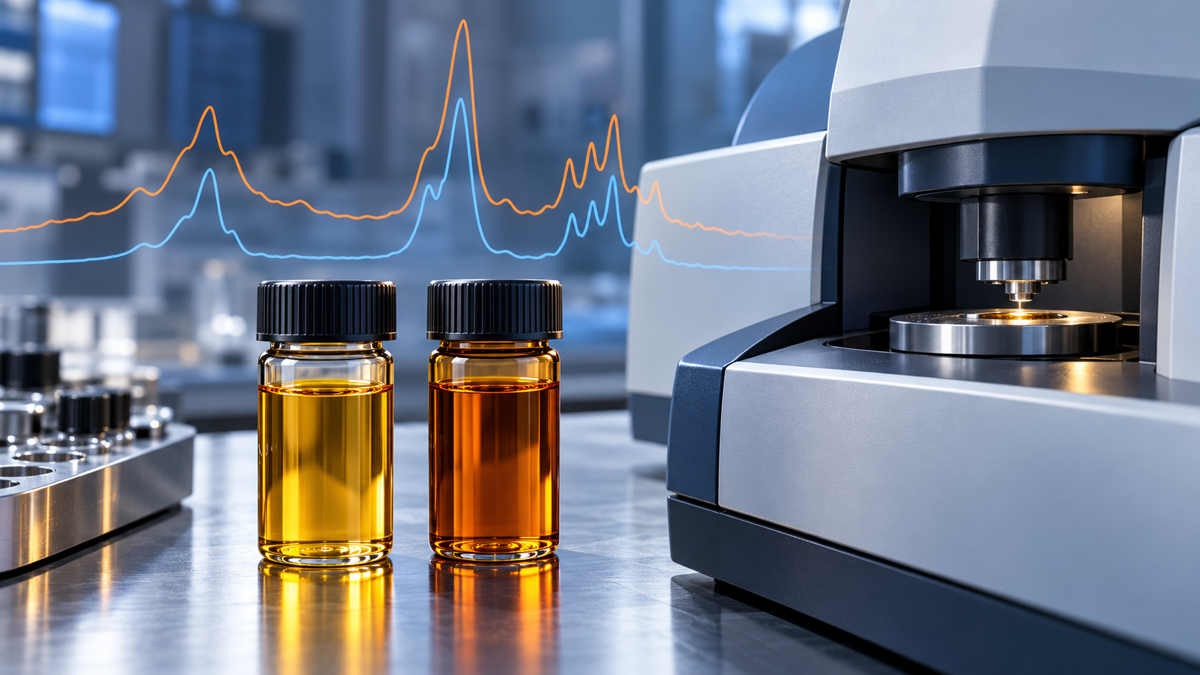
Two thermal-oil reports may both show an “oxidation” result, yet a higher or lower number does not automatically establish deterioration or recovery. First confirm that the reports describe comparable samples, use the same result definition and have compatible measurement and processing conditions.
Fourier-transform infrared spectroscopy (FTIR) provides information related to sample composition. A spectrum, peak or software index alone cannot establish a thermal fluid’s remaining life, replacement date or suitability for continued operation. The practical starting question is: what makes these two results comparable?
Ask whether the result is based on peak height, integrated area, a difference from a reference spectrum or a laboratory-defined index. Retain the full result name, unit, method, version and calculation basis. Matching labels do not establish matching measurements.
A screenshot is not a substitute for traceable data. Different vertical scales can change the visual impression of a peak, while similar-looking curves need not have been processed with the same algorithm. Do not estimate degradation from which peak looks taller.
“New oil” should be linked to a precise commercial grade, supplier, batch or source record, and acquisition date. Check whether the system has continued to use that product and whether other grades or suppliers have been introduced.
Also identify the reference spectrum’s role: product identification, calculation of an oxidation result, or another purpose. An identity match does not prove that the used fluid has not changed. If the original reference is unavailable, document the substitute and ask the laboratory what conclusions it can support. A generic database spectrum must not silently become the system’s initial baseline.
A new-fluid reference is a sample or spectrum used for comparison. A spectral baseline is part of data processing. Request these as separate items to avoid ambiguity.
Have the laboratory confirm whether measurement mode, optical path length, normalization, baseline treatment and result algorithms are compatible. These are laboratory interpretation questions, not an invitation for the user to rescale spectra, subtract backgrounds or invent conversion factors.
After a laboratory, software or algorithm change, seek evidence that the old and new results have been bridged. Until comparability is confirmed, mark the change point and retain separate series rather than drawing one uninterrupted trend.
Record added product, batch, quantity and date alongside partial changes, mixing events and formulation notices. A lower result after a top-up may coincide with a different composition background. It does not by itself prove that deposits have decreased, the cause of a problem has been removed or the fluid is “as new.”
After a formulation change, ask the supplier about product-document revisions and ask the laboratory whether the existing reference remains suitable. If a new comparison starting point is needed, preserve the earlier series and explain the transition.
| Check | Evidence to retain | If information is missing |
|---|---|---|
| Fluid and sample identity | Grade, supplier, sample ID, location and date | Record identity linkage as unconfirmed |
| New-fluid reference | Source, batch or ID, date and purpose | Ask the laboratory to confirm suitability |
| Result definition | Method/version, unit and peak/area/difference/index basis | Do not combine into a quantitative trend |
| Measurement and processing | Laboratory explanation of mode, path length, normalization and algorithm | Mark cross-condition comparability as pending |
| Fluid changes | Top-up, mixing, replacement and formulation timeline | Avoid assigning one cause to the change |
| Written interpretation | Report number, respondent, scope and date | Keep open questions and responsible parties visible |
This is an evidence-organization checklist, not a standard-prescribed test form. Document receipt, confirmation of comparability and approval of an application decision are different stages.
Record three levels: the measured change, the laboratory’s possible explanations, and conclusions supported by additional evidence. An FTIR change alone does not prove overheating, water ingress or off-specification product. The laboratory should assess the specific fluid’s composition background, overlapping signals and method suitability.
Select supporting acid-number, viscosity, water or other analysis to answer the actual question, not to complete a fixed package. Read the results with sample location, operating phase, temperature and maintenance events. Preserve disagreements between indicators rather than selecting only a favourable result.
“For the identified reports and samples, please confirm the FTIR result name, unit, method version and calculation definition; the reference source and purpose; and whether acquisition and processing conditions are compatible with the previous result. Please explain the method’s applicability to this thermal fluid, which comparisons are valid, how top-up or formulation records affect interpretation, and what evidence is still needed.”
Where comparability is established, state that the result changed under the confirmed comparison conditions. Where it is not, state that cross-method comparability is pending. After a top-up, state that the changed fluid background requires interpretation. None of these statements alone is a service-life or continued-operation guarantee.
An effective FTIR oxidation trend connects samples, references, methods and events. Establish comparability first, then have the laboratory and relevant technical parties explain the change. That makes the trend a defensible input to a decision rather than a standalone diagnosis.
Related reading: Reading a heat transfer fluid analysis report and Investigating rising thermal-oil viscosity.
Petro Online, Advancements in Lubrication Oil Condition Monitoring through FTIR Spectroscopy, February 28, 2024. This industry article is background reading on lubricating oil, not proof that a method applies to every thermal fluid. The checklist here is an editorial evidence framework, not a standard clause. No universal spectral window, alarm threshold or test procedure is prescribed, and no standalone FTIR result is used to approve fluid replacement or continued operation.